Use Case & Impact Story
From 100 Hours to 25: How One TV Production Turned a 3-Day Script Breakdown Into a 2-Minute Task
A leading episodic drama eliminated manual script breakdown entirely — freeing production assistants to focus on the content instead of the paperwork.

The Results at a Glance
Executive Summary
For a 10-episode TV production, manually breaking down scripts — tagging locations, characters, time of day, and scene context — used to consume up to three full days of dedicated administrative work before a single schedule could be built.
With Scenatik, that same script breakdown data entry process now takes under two minutes. The broader end-to-end breakdown and scheduling workflow, historically a 100-hour undertaking, has been compressed to roughly 25 hours — a 4x productivity gain — while eliminating the manual first-pass assignment stage altogether. The result: fewer errors, faster pre-production, and production assistants who spend their time on creative and logistical judgment calls instead of retyping scene headers.
The Challenge: A Broken, Manual Bottleneck in Pre-Production
Before Scenatik, script breakdown was — and for most productions, still is — one of the most time-consuming and error-prone stages of pre-production. A single production assistant or coordinator would manually read through every scene of every script, then hand-enter the details needed to build a workable schedule.
- Every location, and whether it's interior or exterior
- Every lead, supporting, and guest character appearing in a scene
- The time of day for each scene — morning, day, evening, or night
- A first-pass assignment of all of the above into a breakdown sheet, later re-checked and corrected by a second team member
For a standard 10-script TV show, this process alone could stretch across up to three full working days — before scheduling had even begun. Multiply that across a full season, and production teams were losing the better part of a week just getting scripts into a usable, structured format.
Worse, because the process was manual, it was also inconsistent: character names spelled differently across scenes, locations logged under slightly different labels, and time-of-day tags applied based on individual judgment rather than a single standard.

Before, one person could lose three days just getting a season's worth of scripts into a spreadsheet we could actually schedule from. And that was before we even found the mistakes.
Line Producer, TV Drama Series
The Solution: Automated, AI-Driven Script Breakdown
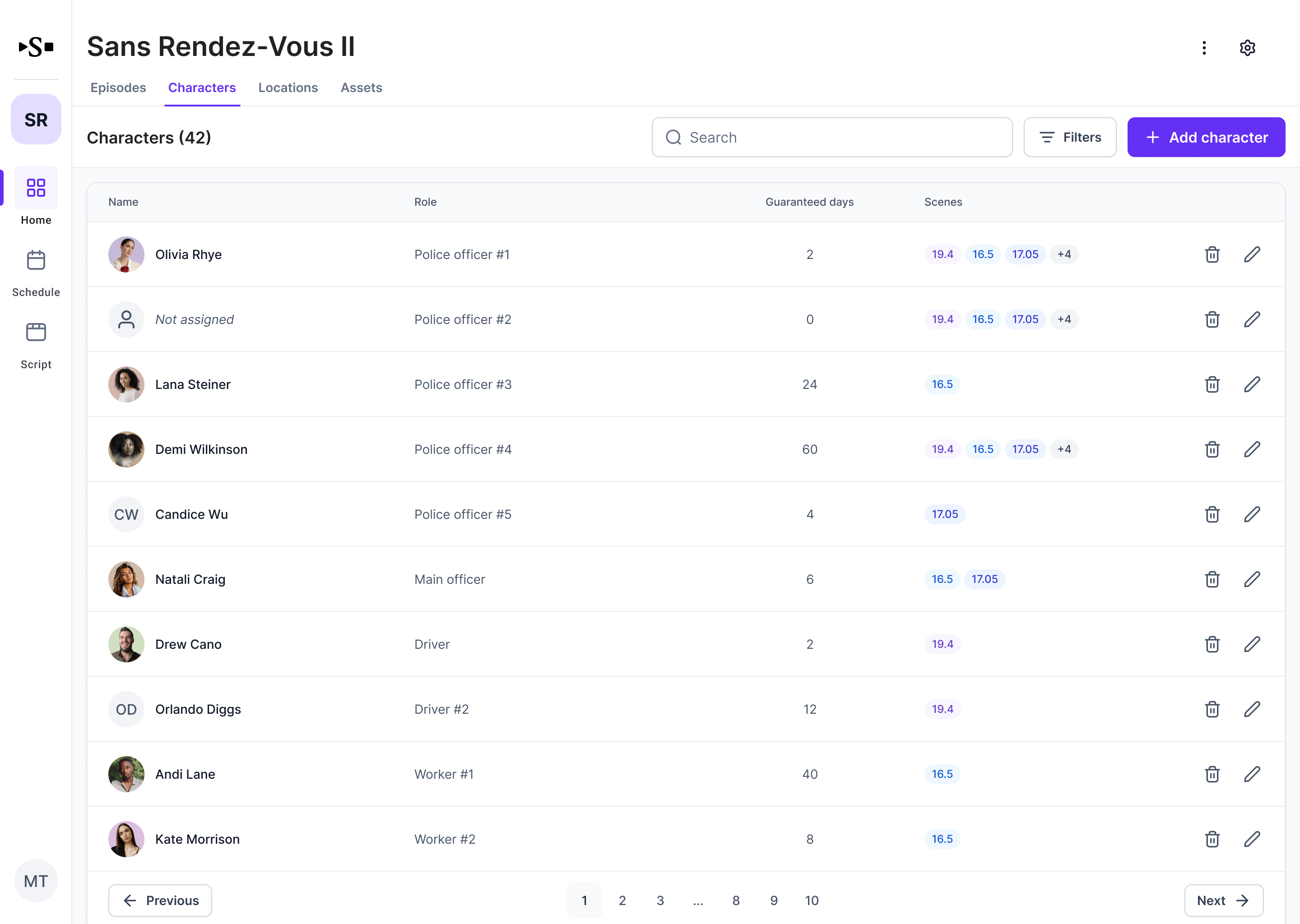
The production team deployed Scenatik to fully automate the script breakdown stage — replacing manual data entry and the traditional first-pass assignment process with a single automated read of the script.
What Scenatik Automated
What Changed in the Workflow
Instead of a production assistant manually reading and tagging every scene, then running a second pass to catch errors, the team now uploads the script directly into Scenatik. The platform performs the extraction and assignment automatically — meaning the traditional first-pass manual breakdown step is eliminated entirely. The only human input required is the final script review, not the breakdown itself.
Before vs. After: Manual Breakdown vs. Scenatik
| Task | Before Scenatik | With Scenatik |
|---|---|---|
| Data entry — location, lead, support & guest characters (10-script TV show) | Up to 3 days | ~2 minutes |
| Character-to-scene assignment | Manual, inconsistent accuracy | 80–90% automated accuracy |
| Location assignment | Manual, prone to mislabeling | 100% accuracy |
| Time-of-day (chrono) tagging | Manual, subjective per scene | Fully automated |
| Interior / exterior tagging | Manual | Fully automated |
| First-pass breakdown assignment | Required, separate step | Eliminated entirely |
| Full breakdown & scheduling process | ~100 hours | ~25 hours |
The Impact & ROI
- 4x productivity gain across the full breakdown-to-schedule pipeline — from 100 hours down to 25
- Near-total elimination of manual data entry — a 3-day task compressed into roughly 2 minutes for a full 10-script season
- 100% accuracy on location assignment, removing a recurring source of scheduling and logistics errors
- 80–90% accuracy on character assignment across leads, support, and guest roles, dramatically reducing the manual correction workload
- First-pass manual breakdown fully retired — teams now only need to run the script breakdown itself, not a separate assignment stage
- Reallocated human capital — production assistants and coordinators redirect the hours they recover toward creative and logistical decision-making, not repetitive administrative entry
The breakdown used to be a job in itself. Now it's a byproduct of uploading the script. Our production assistants finally get to focus on the content, not the paperwork.
Production Manager, Episodic TV